
One article a day, three levels your way.
Free graded English reading: every article comes in Easy, Medium and Hard, with listen-along audio. Vocabulary and quizzes are free with an account. Sign up free →
Longer sentences, more descriptive words (about B1)
Help Scientists Study Dust in Overlapping Galaxies
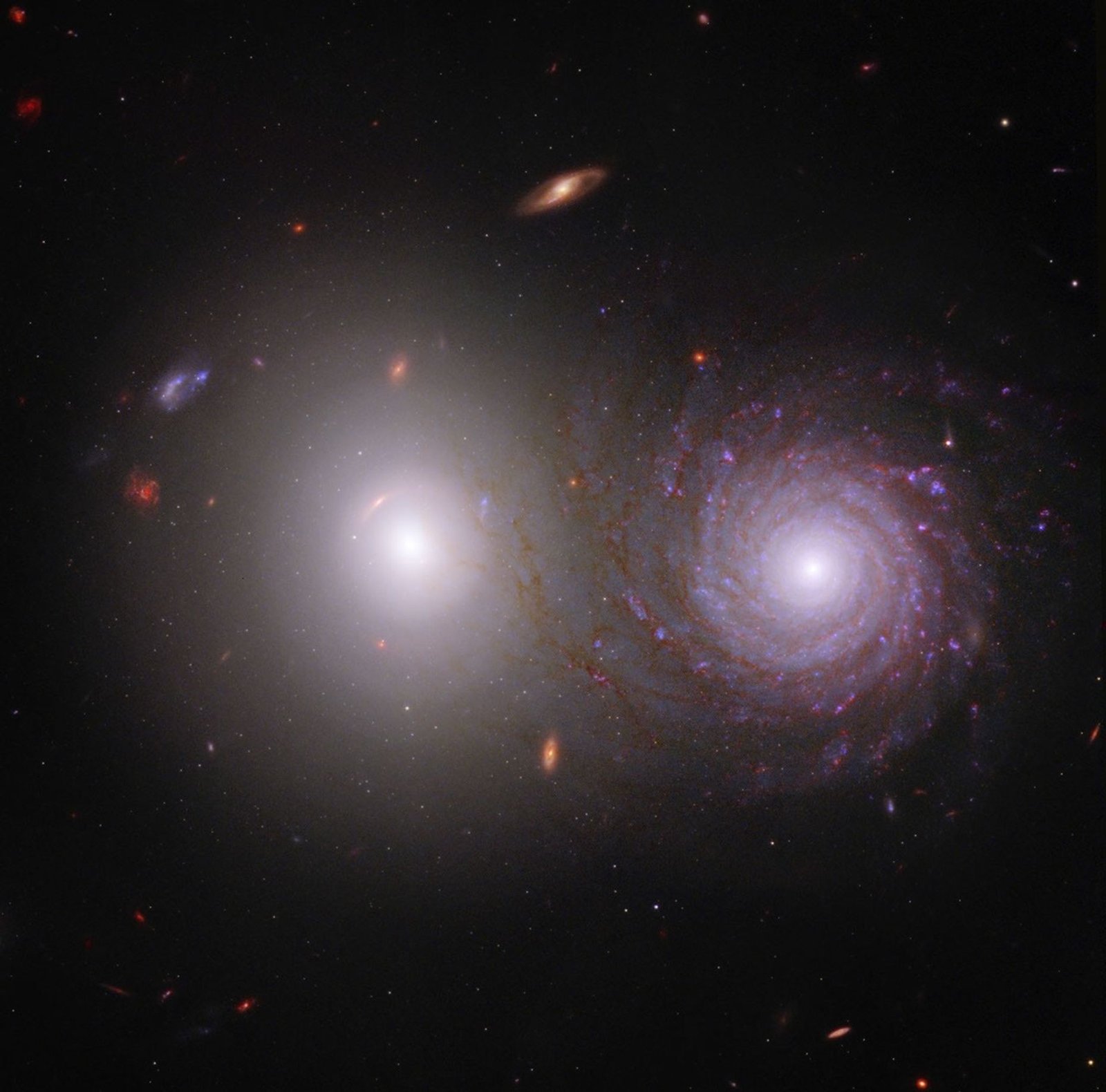
Galaxies are huge groups of stars, gas, and dust held together by gravity and spread across space. Sometimes two galaxies fall along the same line of sight from Earth or a space telescope, so they appear to overlap. These uncommon cases give astronomers a way to examine dust inside a distant galaxy, which is usually hard to observe directly. That opportunity is the aim of NASA’s Overlap Zoo project.
When one galaxy lies behind another, light from the farther object can pass through the nearer one. Dust in the nearer galaxy then appears as dark outlines against that background light. By examining those outlines, researchers can map the dust and study how it absorbs, scatters, and reduces starlight. Such measurements can also help improve estimates of distances to remote objects.
Before those studies can proceed, the pairs themselves must be located, so Overlap Zoo is seeking public help. Trevor Butrum, the project lead and a graduate student, said that galaxy observations are growing in number and quality. Astronomers are finding it extremely hard to check every possible pair. He described volunteer assistance as essential to building the largest and cleanest catalog of overlapping pairs for later analysis.
Volunteers examine images already marked by Galaxy Zoo participants as possible overlaps. Overlap Zoo explains how to confirm that a pair is present, note important features of each galaxy, and trace their outlines. Contributors can classify as many images as they wish and learn the task while doing it. Their work is meant to produce the first large catalog of galaxy pairs suitable for dust research. It can also support a major gain in the accuracy of astronomical estimates. People can start without previous experience, because a few minutes of attention is enough to add useful observations.
How can volunteers help scientists learn more about dust in distant galaxies?
Adapted from NASA Universe.
Select Vocabulary or Quiz to practice.
Vocabulary
10 key words — tap a word for its meaning and an example
Quiz
10 questions