
One article a day, three levels your way.
Free graded English reading: every article comes in Easy, Medium and Hard, with listen-along audio. Vocabulary and quizzes are free with an account. Sign up free →
Longer sentences, more descriptive words (about B1)
Tracking Fruit Flies with Harmonic Radar for Smarter Crop Protection
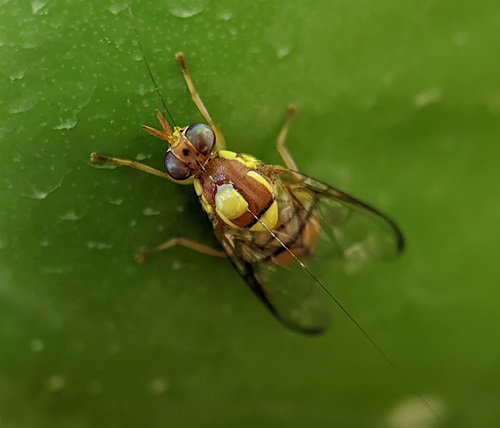
Members of the Tephritidae family of fruit flies eat large amounts of fruits and vegetables. These insects create ongoing difficulties for growers and the public. Several species have invaded the United States and cause losses of millions or even billions of dollars. Permanent establishment on the mainland would impose significant barriers to global trade.
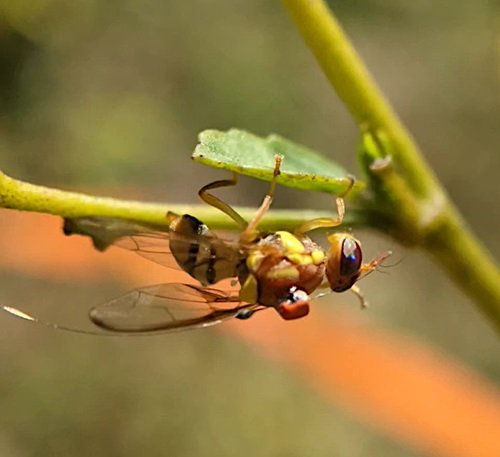
Effective control of these pests depends on knowledge of how they fly. Matthew Siderhurst leads a scientific team in Hawaii that uses advanced tracking technology outdoors. They apply harmonic radar, a method first created to locate people caught in avalanches. Reflector tags on the flies reflect a signal to a transceiver and generate data on movement. The tags operate without their own energy source.
In contrast to long-accepted ideas, the research showed that the flies actively steer their flight paths according to wind cues. They do not drift passively with the air currents. Fruit flies display a notable level of directional persistence and follow substantially straighter routes than expected. Single flies tend to maintain an overall heading when shifting from tree to tree. These insects are similar in size to a housefly and attack many kinds of fruits and vegetables.
These findings could help identify outbreak patterns and predict environmental shifts that affect fruit fly actions. Farmers might then modify their control methods. Laboratory-raised flies were used so that the insects’ true movement capacity would not be undervalued. Further outdoor tests with wild insects are advisable since wind shaped the direction of their flights. The method is both practical and inexpensive because the transceiver units can be obtained commercially. Future work should explore the roles of habitat type, vegetation density, and other factors including wind.
Why is it useful for farmers to understand how fruit flies respond to wind?
Adapted from USDA ARS Research News.
Select Vocabulary or Quiz to practice.
Vocabulary
10 key words — tap a word for its meaning and an example
Quiz
7 questions