
One article a day, three levels your way.
Free graded English reading: every article comes in Easy, Medium and Hard, with listen-along audio. Vocabulary and quizzes are free with an account. Sign up free →
Longer sentences, more descriptive words (about B1)
What Is the Atlantic Meridional Overturning Circulation?
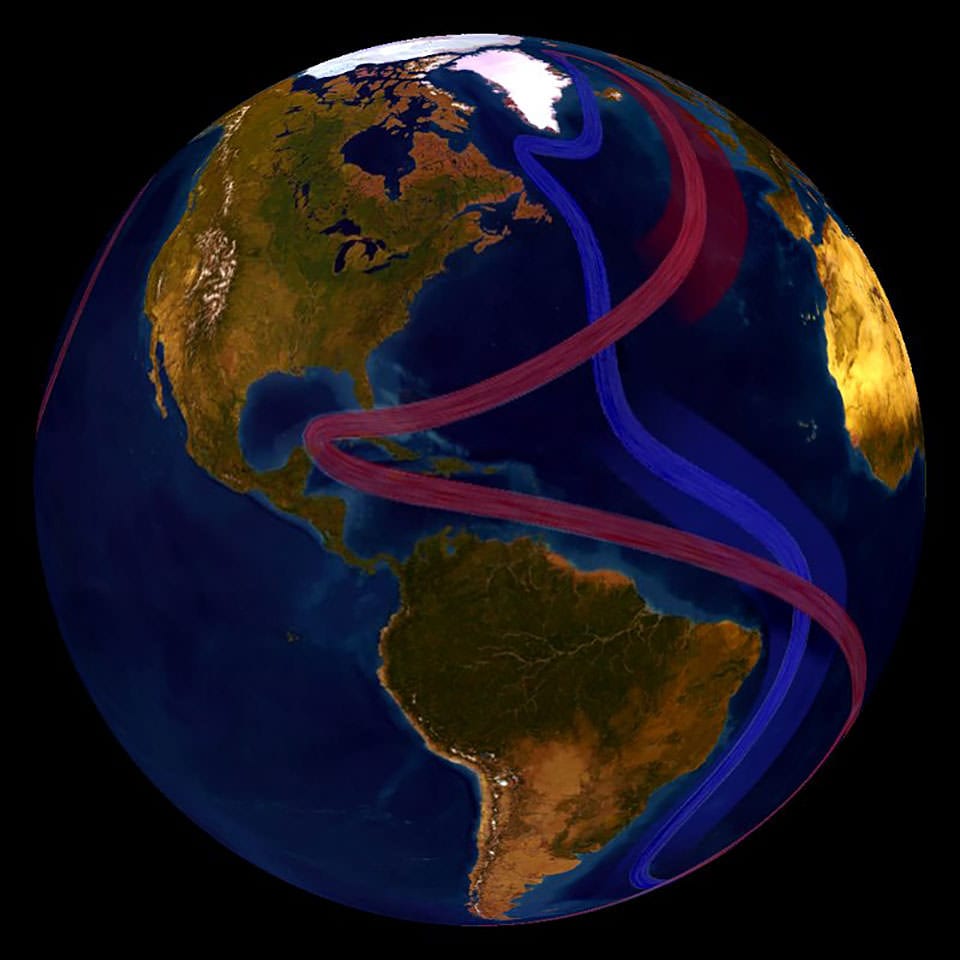
Ocean water is kept in motion by several kinds of currents that form in different ways. Near the coast, the sun and moon help produce tidal currents, while wind shapes the surface flow. Other, much slower currents run from the surface down to the seafloor. They are powered by differences in temperature and salt, a process known as thermohaline circulation. These deeper flows travel within a vast global conveyor belt, and the AMOC is part of that system.
The Atlantic Meridional Overturning Circulation, or AMOC, moves water north and south inside the Atlantic Ocean. It then carries that water back again and forms a long loop. Along the way, it delivers heat to many regions and transports nutrients that ocean life needs. The cycle begins when warm seawater near the surface travels toward the poles, as in the Gulf Stream of the North Atlantic. There the water cools and sea ice forms, and salt remains in the liquid, so the water grows denser and sinks. That dense water is carried south at depth, then returns through upwelling, when deep water rises, warms, and closes the loop.
The AMOC and the wider global conveyor belt operate very slowly. A cubic meter of water is estimated to need about 1,000 years to finish one full circuit. Although the circulation is already slow, some evidence indicates that the AMOC is slowing still more. NOAA funds studies meant to clarify this possible further decline. These studies also examine its role in coastal sea-level change and its links to extreme events.
Continuing climate change raises the question of whether the AMOC might weaken further or halt altogether. Research shows that it has grown weaker during the last century. However, it remains uncertain whether the decline will continue or whether the circulation will stop. If the AMOC keeps slowing, the climate effects could be wide-ranging. For example, if the planet keeps warming, meltwater from polar ice would move South Africa's rain belt and bring drought to millions of people. It would also raise sea levels along the U.S. East Coast.
What could happen to people and coastlines if the AMOC continues to slow?
Adapted from NOAA Ocean Facts.
Select Vocabulary or Quiz to practice.
Vocabulary
11 key words — tap a word for its meaning and an example
Quiz
10 questions