
One article a day, three levels your way.
Free graded English reading: every article comes in Easy, Medium and Hard, with listen-along audio. Vocabulary and quizzes are free with an account. Sign up free →
Longer sentences, more descriptive words (about B1)
Webb Finds the Home of the Farthest Fast Radio Burst
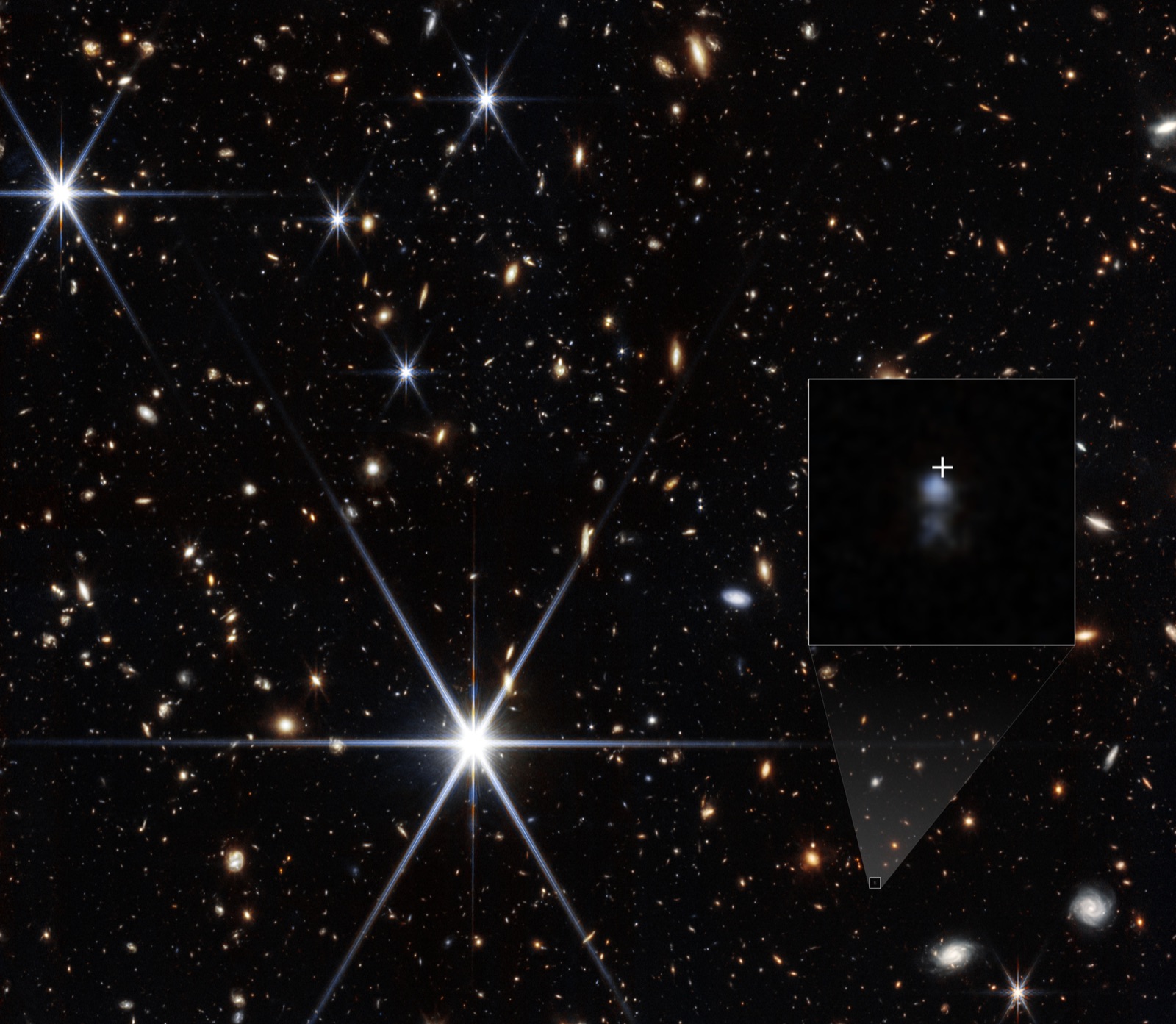
Fast radio bursts are very short flashes of radio waves that come from far across the universe. Each one lasts only a few milliseconds, and astronomers first found them in 2007. Scientists still do not know what causes them, partly because most bursts are seen only once. Now a team using NASA's James Webb Space Telescope has found the galaxy of the farthest fast radio burst (FRB) seen so far. The result gives new clues about what kind of powerful event creates these signals. The burst was detected on March 4, 2024, by the MeerTRAP team using the MeerKAT telescope. It was named FRB 20240304B, and its radio signal suggested that it came from an enormous distance. To confirm this, astronomers needed to study the galaxy that hosted the burst. They knew exactly where the burst came from, but the largest telescopes on the ground could not see a galaxy there. So the team turned to Webb.
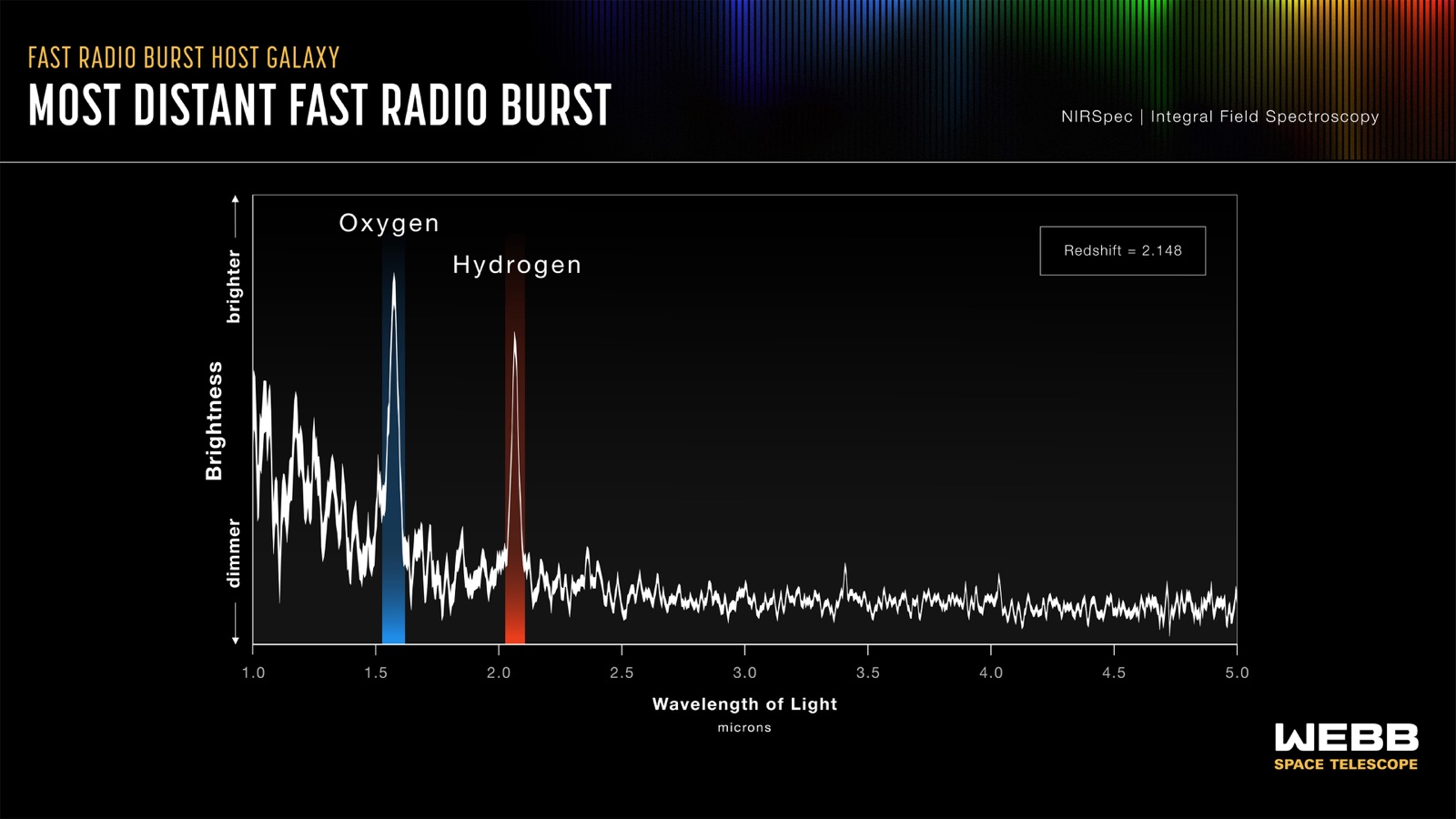
Webb's NIRCam instrument found a galaxy in the right place, and its NIRSpec instrument measured the galaxy's redshift precisely. The redshift was 2.148, which places the galaxy just 3 billion years after the big bang. Nearly all the FRBs found before this one happened billions of years later. The host galaxy was also a surprise. Galaxies linked to FRBs tend to be large and full of stars, but this one was 1,000 times less massive than the team expected. Manisha Caleb of the University of Sydney, who led the study, said they expected a big, well-formed galaxy. Instead, they found a small dwarf galaxy that was actively making new stars. The galaxy existed during "cosmic noon," a time when stars were forming at their highest rate in the history of the universe. Its star-formation rate suggests that most of its stars may have formed in only 30 million years.
This matters because scientists have two main ideas about what creates FRBs. One idea is that two neutron stars merge, but this process is expected to take billions of years. If that were true, FRBs should mostly appear in older galaxies. The other idea is that a young, highly magnetic neutron star called a magnetar produces the burst, perhaps through starquakes. A magnetar is left behind when a massive star explodes as a supernova, so a burst could happen fairly soon afterward. This idea fits young galaxies like the host of FRB 20240304B. Caleb said the results suggest that it is very unlikely that this burst was produced by a merger.
The burst also helped the team study the space between the burst and Earth. Xavier Prochaska of the University of California, Santa Cruz, compared an FRB to a cosmic flashlight. It lights up everything along its path and carries a mark of everything it passes through. In this way, scientists can use FRBs to trace the "cosmic web," the matter and structures that are otherwise invisible. This burst showed signs of two structures: a galaxy cluster not known before and the nearby Virgo Cluster. The team hopes to find more distant FRBs, and MeerKAT may be able to detect several each year at redshifts above 1.0. Webb will be essential for studying the galaxies that host them.
Why was the host galaxy of FRB 20240304B a surprise to the researchers, and what does it suggest about the cause of fast radio bursts?
Adapted from NASA Universe.
Select Vocabulary or Quiz to practice.
Vocabulary
11 key words — tap a word for its meaning and an example
Quiz
7 questions