
One article a day, three levels your way.
Free graded English reading: every article comes in Easy, Medium and Hard, with listen-along audio. Vocabulary and quizzes are free with an account. Sign up free →
Longer sentences, more descriptive words (about B1)
Hubble Finds Oxygen Missing From Nearby Dwarf Galaxies
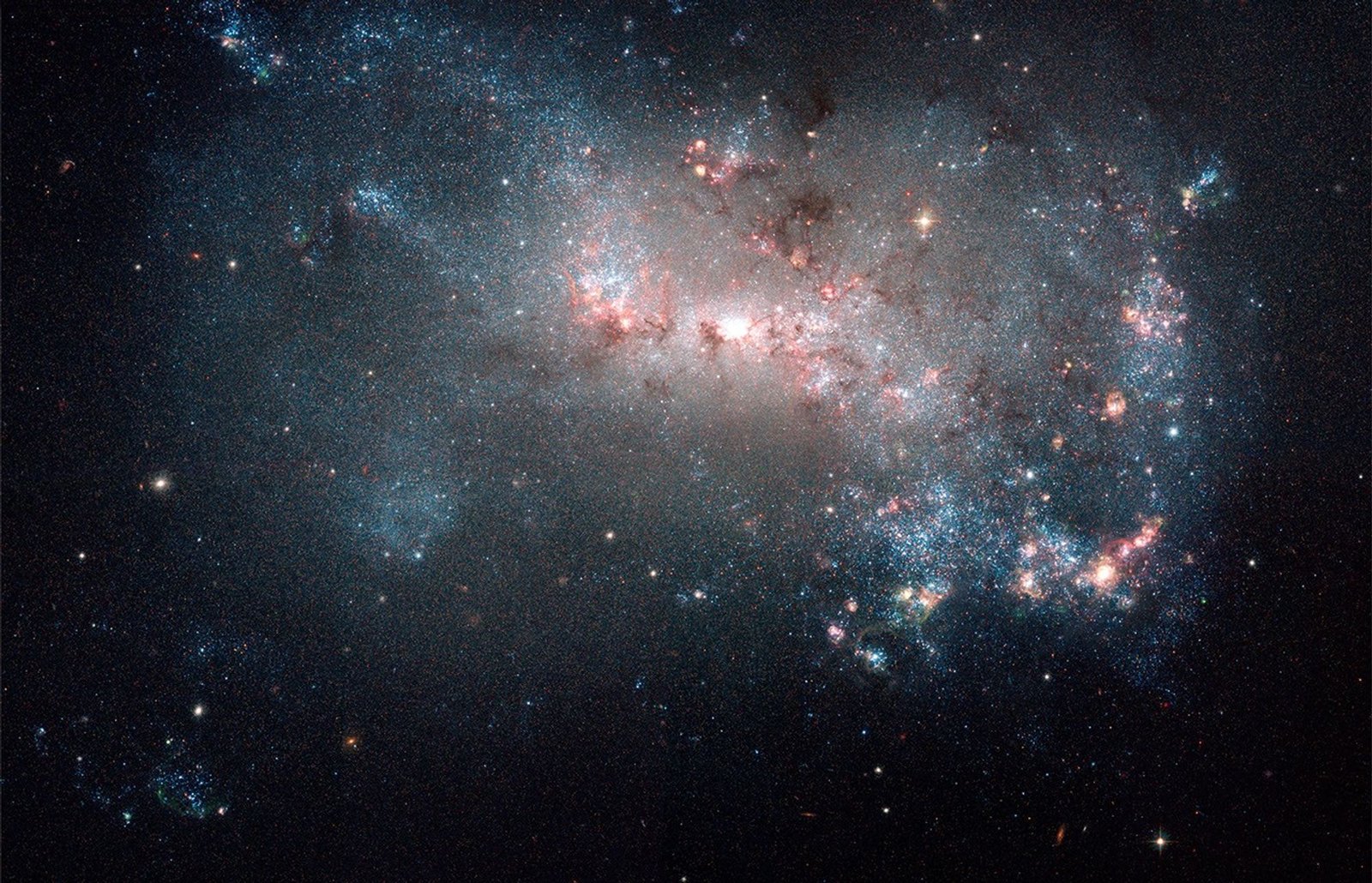
Researchers using NASA's Hubble Space Telescope have found that dwarf galaxies are missing a surprising amount of oxygen. The team studied 37 of these small galaxies, which have between several thousand and several hundred million stars. Computer simulations indicate that these galaxies should hold much more oxygen. Oxygen also serves as a marker for a broader group of heavy elements. The question is where the missing oxygen has gone.
Co-investigator Grace Telford of the University of Utah explained the reasoning behind the puzzle. Stars make oxygen, and stars sit inside galaxies, so any oxygen that is missing must have been pushed out. Pushing it out takes a great deal of energy. This energy comes from massive stars and supernova explosions, which can drive material out of a galaxy and into the space between galaxies. According to the study, winds from supernovae appear to remove oxygen from low-mass galaxies more efficiently than current models assume. As a result, dwarf galaxies keep only a small portion of the oxygen their stars produce.
The study is part of the Galaxies Losing Oxygen via Winds (GLOW) project, which NASA and the National Science Foundation fund. Its scientists followed oxygen through stars, through the gas between stars, and through the space between galaxies. They chose oxygen because it is the next most common element after hydrogen and helium, and it is fairly easy to measure. Its formation is also well understood, so it is a dependable guide to how elements spread through a galaxy. GLOW leader Kristen Wingfield McQuinn of Rutgers University said that tracking oxygen helps researchers understand how galaxies evolve. To do this, the team used archived Hubble images to study groups of stars and when they formed. They combined these images with data from the retired Spitzer Space Telescope and two ground-based facilities. The aim was to learn how oxygen is divided among the stars, gas, and dust of each galaxy. The team picked the 37 galaxies for two reasons. Their masses fall in the range where theory predicts that supernovae blow out a growing amount of oxygen. They are also close enough for Hubble to separate individual stars, which is impossible for most known dwarf galaxies.
Astronomers already suspected that galaxies push out much of their oxygen, but where it ends up was unclear. A 2014 study found that star-forming galaxies like the Milky Way lose much of their oxygen. Some of it sits in the circumgalactic medium, a thin halo of gas beyond the galactic disks. The GLOW team extended this research to low-mass galaxies with many different masses and environments. It is still uncertain whether most of the missing oxygen is in the circumgalactic medium or has left the galaxies' surroundings altogether. McQuinn hopes to study even smaller galaxies and has an approved program to search for them with the Roman Space Telescope. Telford plans to use Hubble to study the individual massive stars that make oxygen and eject it from their galaxies.
Why do the researchers think supernova winds may explain the missing oxygen in dwarf galaxies?
Adapted from NASA Universe.
Select Vocabulary or Quiz to practice.
Vocabulary
12 key words — tap a word for its meaning and an example
Quiz
7 questions