
One article a day, three levels your way.
Free graded English reading: every article comes in Easy, Medium and Hard, with listen-along audio. Vocabulary and quizzes are free with an account. Sign up free →
Longer sentences, more descriptive words (about B1)
Cyclone Arnab Hits India's East Coast
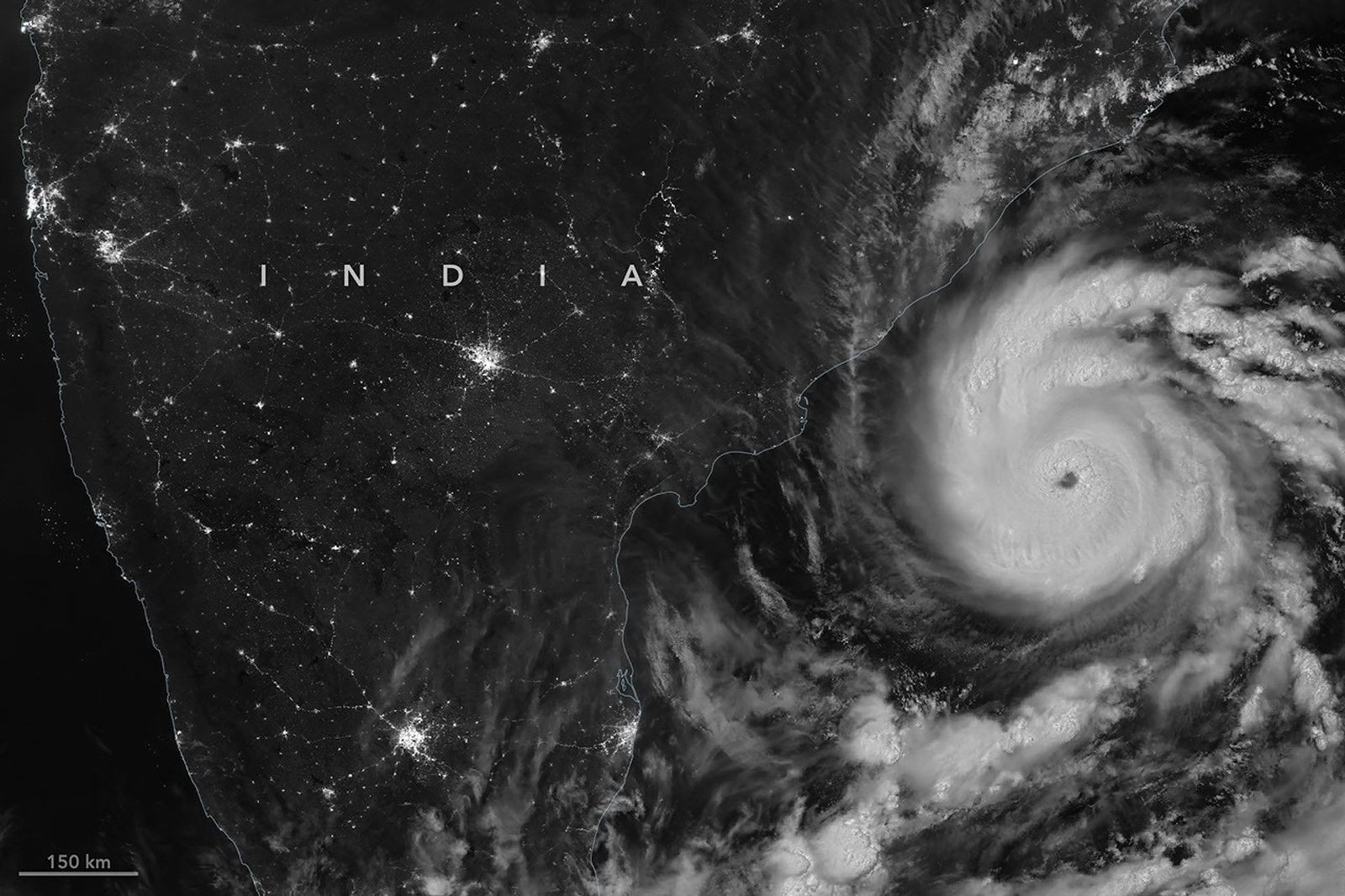
Arnab was the first named storm of the 2026 North Indian Ocean cyclone season. It formed over the Bay of Bengal on October 25. This was fairly late, because named cyclones in this region usually appear in April or May.
A satellite captured a nighttime image of the storm on October 26. At that time, India's weather agency reported sustained winds of about 140 kilometers (85 miles) per hour. Early on October 28, Arnab reached land and crossed the coast of Andhra Pradesh and Yanam with winds of 130 kilometers per hour. The agency calls a storm of this strength a "very severe cyclonic storm," which is roughly similar to a Category 1 storm on the Saffir-Simpson hurricane wind scale.
The cyclone came ashore between Bapatla and Visakhapatnam. This stretch of coast has many people and includes large cities, farmland, and fishing communities. News reports described widespread damage. Trees were torn out of the ground, and crops and homes were flooded. Fishing was restricted, and transportation and electricity networks were disrupted. Before the storm struck, authorities had moved tens of thousands of people out of vulnerable coastal areas.
Arnab developed while an El Niño was under way. El Niño is a climate pattern with unusually warm water in parts of the equatorial Pacific Ocean, and it appears about every two to seven years. These ocean changes can affect the atmosphere and shift weather patterns around the world, including rainfall, winds, tropical cyclones, fires, and floods. In the Bay of Bengal, some research suggests that El Niño is linked to fewer tropical cyclones. Researchers have found that storms in this area are both less frequent and less intense during El Niño years.
Why was it important that authorities moved people out of coastal areas before Arnab reached land?
Adapted from NASA Earth Observatory.
Select Vocabulary or Quiz to practice.
Vocabulary
11 key words — tap a word for its meaning and an example
Quiz
7 questions