
One article a day, three levels your way.
Free graded English reading: every article comes in Easy, Medium and Hard, with listen-along audio. Vocabulary and quizzes are free with an account. Sign up free →
Longer sentences, more descriptive words (about B1)
Specialization and Division of Labor: Many Hands, One Big Job
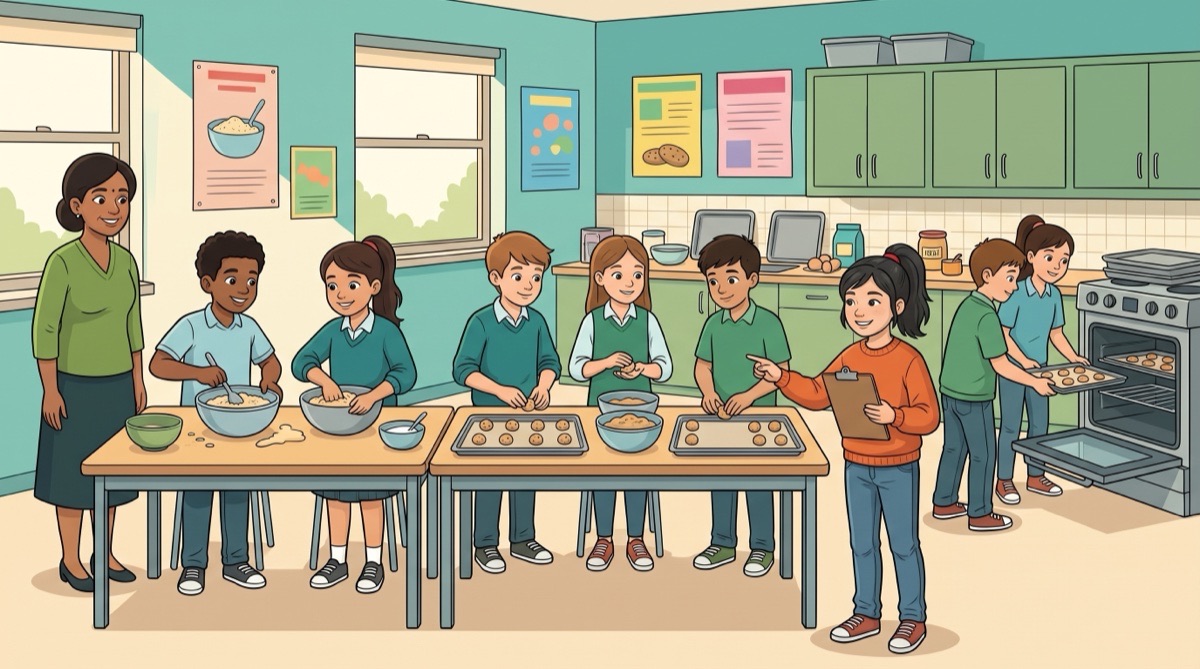
Lucy is twelve years old. She lives in Riverton with her parents and her brothers, Jack and Max. Her class is planning a bake sale to pay for a school trip, and the class needs $200. Each cookie will sell for $2.
On Friday afternoon, the six students in Lucy's group start making cookies. Each student mixes the dough, shapes the cookies and bakes them in the school oven. It sounds simple, but soon there is a problem. Everyone wants the same bowl and the same oven. Dough is on the floor, and a tray of cookies burns.
After one hour, the group has made only 36 cookies.
Lucy says, "Wait. What if we work like a team on a line? Each person does one job."
Her teacher smiles. She says, "Try it, and count what happens."
Trying Teams
First, Lucy puts two students on mixing, two on shaping and two on baking. The cookies move from table to table. This time, the group makes 48 cookies in an hour.
But Lucy notices something. At the shaping table, balls of dough are piling up, while the bakers have nothing to put in the oven. Shaping is the slowest job. So Lucy moves one student from mixing to shaping.
| Plan | Who does what | Cookies per hour |
|---|---|---|
| Plan 1 | Everyone does everything | 36 |
| Plan 2 | 2 mix, 2 shape, 2 bake | 48 |
| Plan 3 | 1 mixes, 3 shape, 2 bake | 60 |
Why Does It Work?
What Lucy's group did is called division of labor. They split one big job into separate tasks, and each person does one task. When a person does the same task again and again, that is specialization. The group's output, the amount they make, rose from 36 to 60 cookies an hour with the same six people.
There are good reasons for this. Workers get faster with practice. They do not waste time changing jobs. And everyone can use what they do best.
Division of labor also has limits. The whole line moves only as fast as its slowest step, so the group must balance the team. If one task is too slow, the others have to wait. And doing the same task all day can be boring.
Back to the Bake Sale
On Saturday, the group makes cookies for two hours with Plan 3. They finish 120 cookies. At $2 each, the cookies earn $240. Plan 1 would have made only 72 cookies and $144.
Lucy looks at the empty tables and says, "Same six people, same two hours. The difference was the plan."
Original ReadLevels article.
Select Vocabulary or Quiz to practice.
Vocabulary
6 key words — tap a word for its meaning and an example
Quiz
6 questions