
One article a day, three levels your way.
Free graded English reading: every article comes in Easy, Medium and Hard, with listen-along audio. Vocabulary and quizzes are free with an account. Sign up free →
Longer sentences, more descriptive words (about B1)
Choice and Opportunity Cost: Every Choice Has a Cost
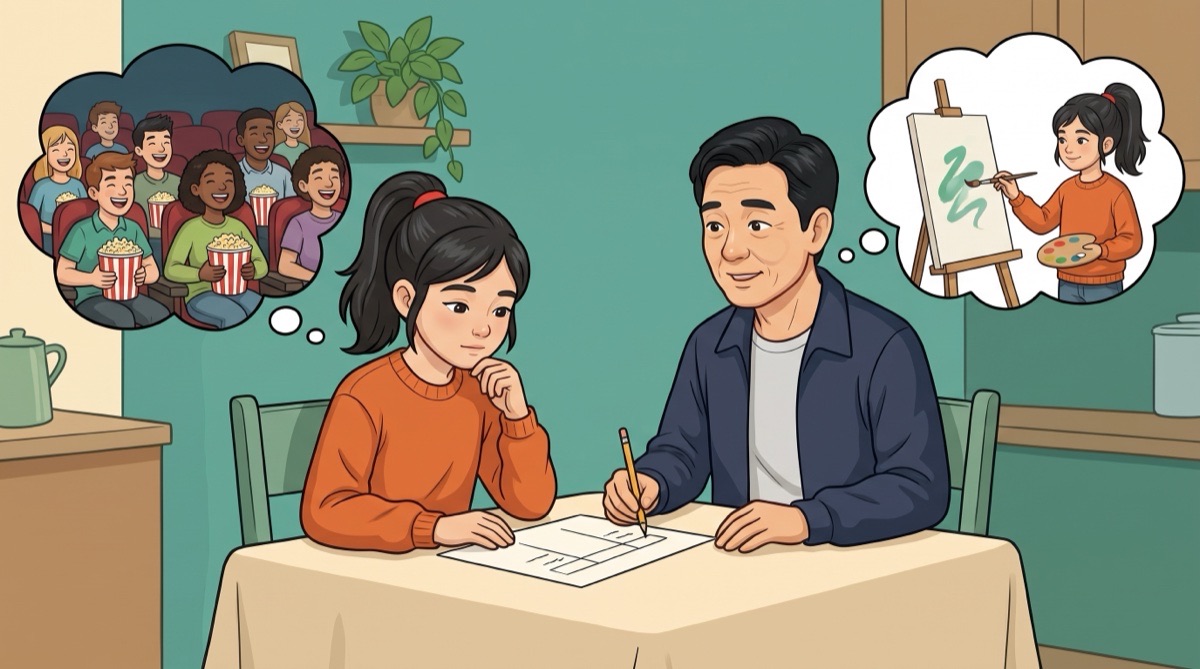
Lucy is twelve years old. She lives in Riverton with her parents and her brothers, Jack and Max. This Saturday, she has $15 in her wallet and two good invitations.
Her friends are going to the movies at two o'clock, and they have saved a seat for her. A ticket costs $12, and Lucy would love to see the new film with them. But at the same time, the library has an art class for teenagers. It costs $15, and Lucy has wanted to learn to paint for months.
At the kitchen table, Lucy puts her head in her hands.
Lucy says, "I can't do both. The movie and the art class are on the same afternoon, and I only have $15!"
Dad sits down across from her. He says, "Let's check the numbers."
He takes a piece of paper and draws a table.
| Choice | Money | Time | What Lucy gets |
|---|---|---|---|
| Movie | $12 | 2 hours | Fun with friends and a new film |
| Art class | $15 | 2 hours | A new skill and a painting to keep |
Lucy can afford only one of them, because the two together cost more than the money in her wallet.
Opportunity Cost
Dad says, "Every choice has a cost. But the cost is more than the price. Think about what you give up."
When Lucy picks one choice, she must say no to the other one. The best alternative that you give up is called the opportunity cost. Each choice has a benefit, such as fun or a new skill, but each one also has a cost. Opportunity cost can include money, time, or both. If Lucy goes to the art class, her opportunity cost is the movie with her friends. If she goes to the movie, her opportunity cost is the art class.
Notice that opportunity cost is only the best alternative, not every other thing she could do. Lucy could also stay home and read, or clean her room, but those are not the choices she wants most.
Opportunity cost also depends on how much you value each choice. If Lucy did not care about the movie, giving it up would cost her very little.
Lucy thinks for a minute. She says, "What if we sell my paintings someday?"
Dad laughs. He says, "Maybe. But first, decide."
Back to the Kitchen Table
Lucy looks at the table once more. She says, "I pick the art class."
Dad asks, "And what do you give up?"
Lucy says, "The movie, and the fun with my friends. That is my opportunity cost."
At four o'clock, Lucy comes home with a small painting of Riverton Bridge. She is a little sad that she missed the movie, but she smiles when Grandma hangs the painting in the bakery window. Lucy says, "I knew the cost, and I still chose it."
Original ReadLevels article.
Select Vocabulary or Quiz to practice.
Vocabulary
6 key words — tap a word for its meaning and an example
Quiz
6 questions