
One article a day, three levels your way.
Free graded English reading: every article comes in Easy, Medium and Hard, with listen-along audio. Vocabulary and quizzes are free with an account. Sign up free →
Longer sentences, more descriptive words (about B1)
Money: Why Everyone Accepts It
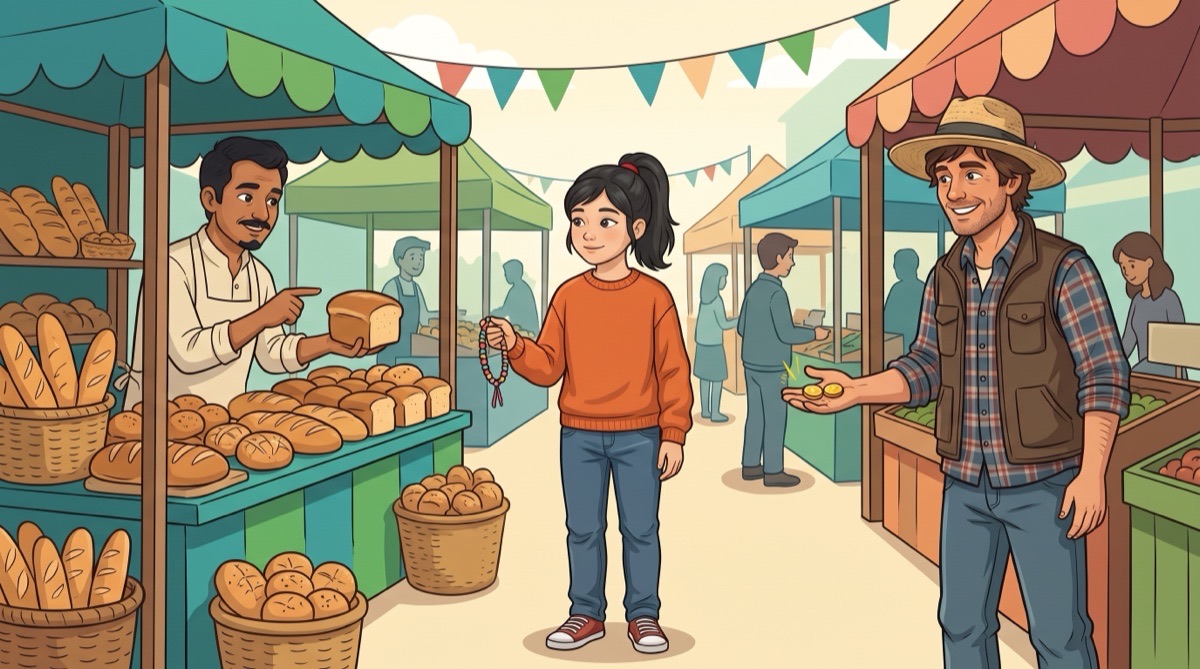
Lucy is twelve years old. She lives in Riverton with her parents and her brothers, Jack and Max. This summer, she learns how to make friendship bracelets, and by Saturday, she has made three pretty ones.
At Riverton Market, Lucy walks past the stalls. The market is busy. Farmers call out their prices, and children run between the tables. She is hungry, and she smells fresh bread at a stall run by a baker she does not know. A loaf costs $3.
Lucy says, "Hello! I have a bracelet. Would you trade it for a loaf of bread?"
The baker looks at the bracelet. He says, "It's beautiful, but I don't wear bracelets. Sorry."
Lucy asks another stall owner, who sells honey. The honey seller says, "I'm not interested in bracelets, but I'll give you a small jar of honey for two of them." Lucy is not sure that is fair, because she worked for hours on those bracelets. Nobody can tell her how many bracelets a loaf of bread is worth.
Uncle Tom, who is passing by with a box of fruit, hears her problem and laughs. He says, "Lucy, this is why people invented money."
What Money Does
Money solves three problems that Lucy has just met.
| Problem with swapping | How money helps |
|---|---|
| The other person may not want your goods | Everyone accepts money for trade |
| It is hard to say what things are worth | Prices measure value in dollars |
| Some goods cannot be kept for later | Money can be kept for later use |
When people use money, trade becomes easier. Everyone accepts money as payment. A price is the amount of money you give for something. Prices measure value: they tell you the value of a bracelet, a loaf or a jar of honey in the same units, which are dollars.
Uncle Tom says, "Lucy, I'll buy two bracelets for $3 each. Then you can buy anything you like."
He adds that money has one more advantage. Bread gets old and bracelets can break, but a dollar can wait in your pocket until you need it.
Back to the Market
Uncle Tom gives Lucy $6 for two bracelets. She walks back to the bread stall and pays $3 for the loaf. The same baker who refused a bracelet takes the money at once and wraps her bread.
Lucy says, "That was easy!"
She still has $3 and one bracelet. She thinks about the hours she spent on the bracelets, and she learns that she likes making things and selling them. Then she sits on a bench, eats her warm bread and thinks, "What if I sell the other bracelet, too? Then I could buy honey."
Original ReadLevels article.
Select Vocabulary or Quiz to practice.
Vocabulary
6 key words — tap a word for its meaning and an example
Quiz
6 questions