
One article a day, three levels your way.
Free graded English reading: every article comes in Easy, Medium and Hard, with listen-along audio. Vocabulary and quizzes are free with an account. Sign up free →
Longer sentences, more descriptive words (about B1)
Price: Why Does It Cost That Much?
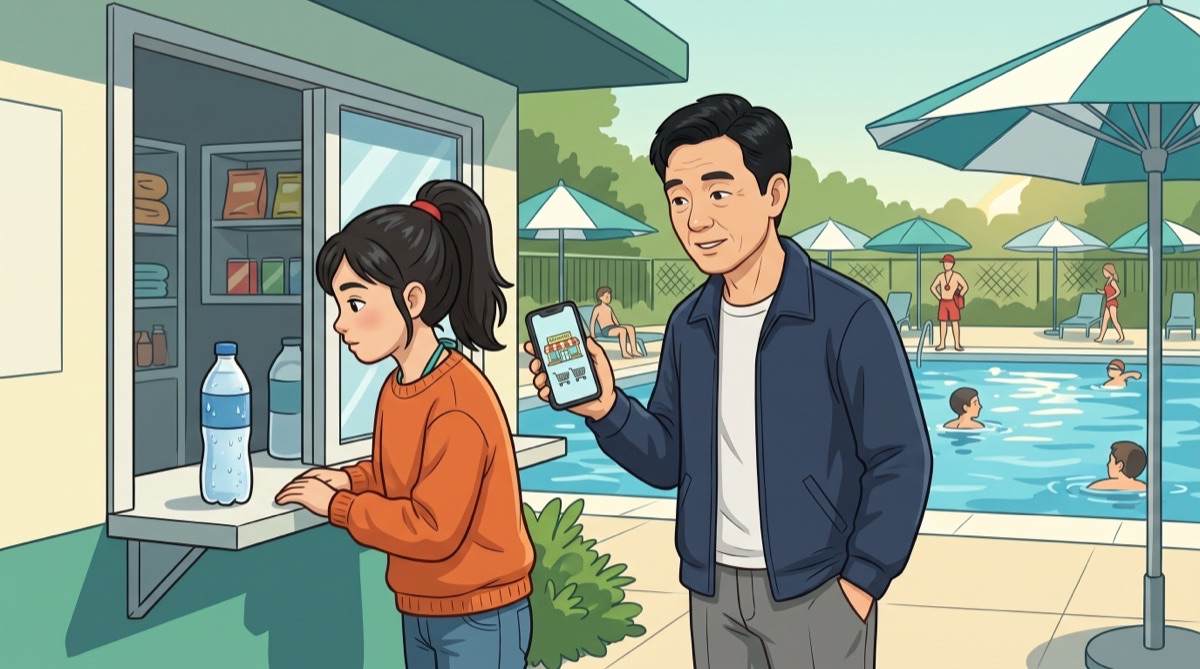
Lucy is twelve years old. She lives in Riverton with her parents and her brothers, Jack and Max. On a very hot Saturday in July, Lucy and Dad go to Riverton Pool. The sun is bright, and the water looks great. Children jump into the deep end, and the air smells like sunscreen.
After an hour, Lucy is thirsty. She walks to the small kiosk near the pool and sees a cold bottle of water. The price is $3.
Lucy says, "Dad, that's crazy! The same water is only $1 at the supermarket."
Dad says, "Let's check the numbers."
He takes out his phone and shows her the supermarket price. Then he asks, "So why do you think the kiosk charges $3?"
Lucy thinks. She says, "Because it's the only place near the pool?"
Dad nods. He says, "Partly. Let's make a list."
| Place | Price of the same water | What is different? |
|---|---|---|
| Supermarket | $1 | Many bottles sold; lower cost each |
| Pool kiosk | $3 | Few sales; hot day; nearby only |
Why Prices Are Different
The price of a good is not only the cost of making it. Three things matter.
First, the seller's costs. The kiosk pays for its space and its worker, but sells only a few bottles. The supermarket sells thousands, so each bottle carries a smaller part of its costs.
Second, convenience. The kiosk is right next to the pool. Buyers pay extra to avoid a long walk.
Third, what buyers are willing to pay. On a hot day, thirsty swimmers are willing to pay more than shoppers who can easily get water at home.
A buyer decides whether the price is fair, and a seller sets it. If buyers refuse to pay, the seller must lower the price.
Back to the Pool
Lucy looks at the cold bottle. Then she smiles. She says, "What if we sell it? I could bring twelve bottles from home and sell them under the big umbrella for $2 each."
Dad laughs. He says, "You would pay $12 for the pack, so each bottle costs you $1. You would make $1 on each bottle."
Lucy says, "And swimmers would save $1 compared with the kiosk."
Dad says, "That is how a price helps people choose. Today, you can pay $3 and be comfortable, or walk home and pay $1. The decision is yours."
Lucy decides to pay for the water. It is cold and perfect. She makes a note on her phone: next time, bring a bottle from home.
Original ReadLevels article.
Select Vocabulary or Quiz to practice.
Vocabulary
6 key words — tap a word for its meaning and an example
Quiz
6 questions