
One article a day, three levels your way.
Free graded English reading: every article comes in Easy, Medium and Hard, with listen-along audio. Vocabulary and quizzes are free with an account. Sign up free →
Longer sentences, more descriptive words (about B1)
Trade Between Countries: Where Does It Come From?
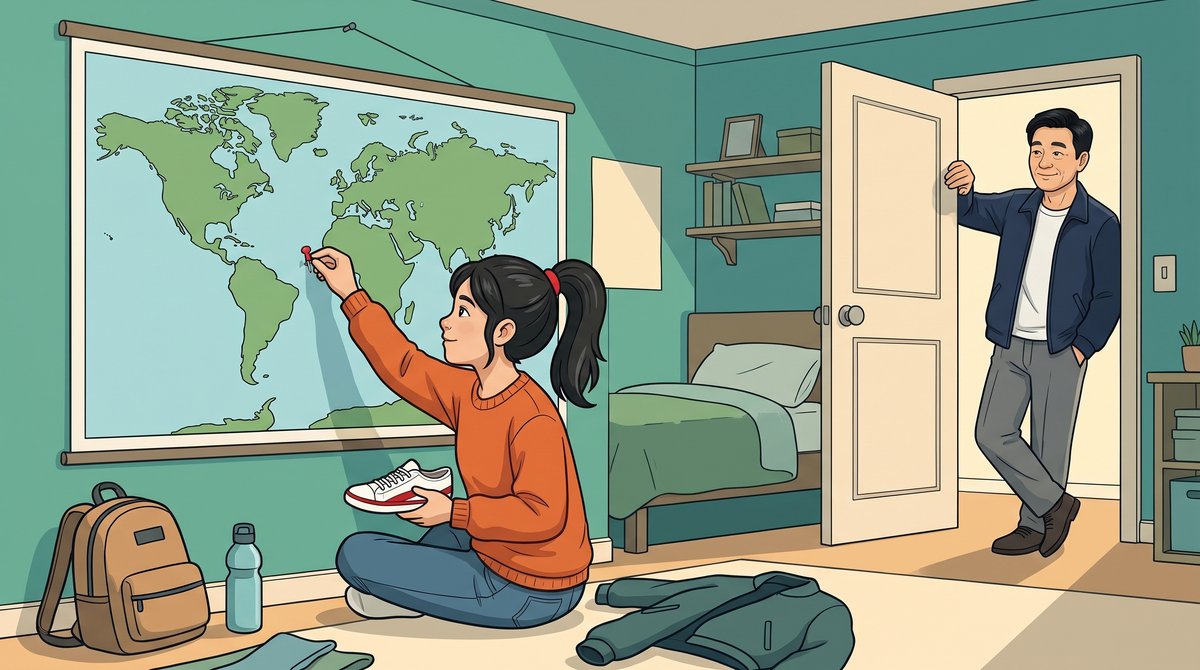
Lucy is twelve years old. She lives in Riverton with her parents and her brothers, Jack and Max. This week, her teacher gives the class a project with a surprising question: Where was your favorite thing made?
Lucy decides to start with her sneakers. They are white with a red stripe, and she wears them every day. After school, she sits on her bed, turns one shoe over, and looks at the tag. Inside, in tiny letters, it says "Made in Vietnam."
Lucy takes out a big world map. She finds Vietnam, and she puts a red pin on it. Then she checks her backpack: made in another country. Her water bottle: another. Her jacket: a third.
The next evening, Lucy shows Dad her map with four red pins. She says, "Dad, how can things from so many places end up in my room?"
Dad says, "That is what trade is. Let's check the numbers."
Dad shows her a simple table on his phone.
| Product | Where it is made | Why there? |
|---|---|---|
| Sneakers | Vietnam | Many skilled workers and large factories |
| Bananas | Ecuador | Warm weather and rich land |
| Wheat | Riverton region | Good soil and flat fields |
Imports, Exports and Gains from Trade
When a country buys goods from another country, those goods are called imports. When it sells goods to another country, those goods are exports. Lucy's sneakers are an import for the United States. Wheat from the Riverton region could be an export.
Countries trade because they are good at different things. One has warm weather, another has many skilled workers, and another has rich land. Each country can specialize in what it does well and then trade for the rest. This gives people more choice and often lower prices. Without trade, the shoes in Lucy's closet would cost much more, and bananas would not be available in Riverton in winter.
But trade also has costs. Goods must be carried by ship, which takes time and money. A storm or a strike can slow the delivery. And when a factory in one country closes because cheaper goods arrive from another, workers can lose their jobs.
Back to the Project
On Monday, Lucy shows her map in class. The teacher says, "How do you feel about it now?"
Lucy says, "I thought my sneakers were just sneakers. Now I see that many people worked together, even though we never met."
The teacher smiles. She says, "That is the quiet strength of trade."
Original ReadLevels article.
Select Vocabulary or Quiz to practice.
Vocabulary
6 key words — tap a word for its meaning and an example
Quiz
6 questions