
One article a day, three levels your way.
Free graded English reading: every article comes in Easy, Medium and Hard, with listen-along audio. Vocabulary and quizzes are free with an account. Sign up free →
Longer sentences, more descriptive words (about B1)
Budgeting: A Plan for Your Money
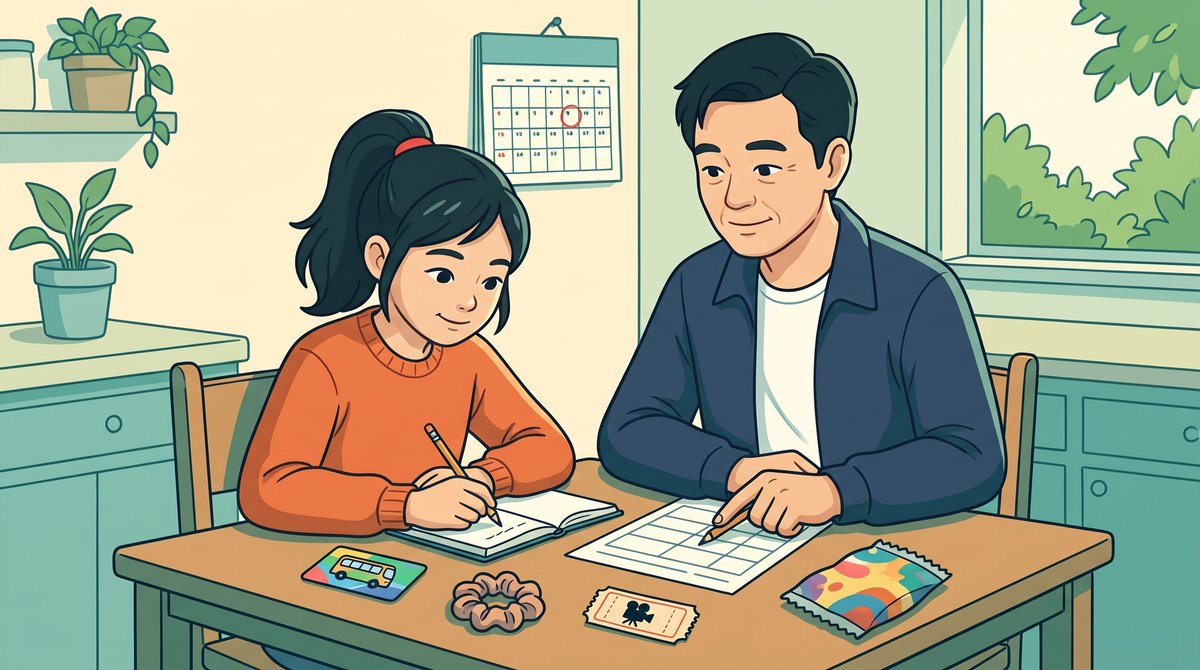
Lucy is twelve years old. She lives in Riverton with her parents and her brothers, Jack and Max. In March, her class announces a school trip to the science museum in the city. The trip costs $60, and the money is due at the end of May. Lucy really wants to go.
She gets $40 every month from pocket money, and she earns about $20 from babysitting. That is $60 a month. But by the end of every month, her wallet is empty, and she never knows where the money went.
At the kitchen table, Lucy tells Dad about the trip. Dad says, "Let's check the numbers."
Dad suggests that Lucy keep a notebook for one week and write down everything that she spends. On Sunday, they look at the page together. Lucy bought a bus card, three snacks at school, a hair band and a movie ticket.
Dad says, "Now we can make a budget."
Making a Budget
A budget is a plan for your income and your expenses. An expense is something that you spend money on. First, Lucy writes how much money comes in each month, which is $60. Then she writes down her expenses in two groups.
A fixed expense is the same every month, such as Lucy's bus card, which costs $12. A flexible expense can change, such as snacks and fun. She can spend less when she needs to.
| Item | Type | Amount per month |
|---|---|---|
| Bus card | Fixed | $12 |
| School trip savings | Goal | $30 |
| Snacks | Flexible | $10 |
| Fun, such as movies | Flexible | $8 |
| Total | $60 |
Dad says, "Your trip costs $60, so with $30 a month, you will have it in two months."
Budgeting also means to track your spending. Each week, Lucy writes down what she spends and compares it with the plan. The plan is not a rule that never changes. It is a guide.
Back to the Kitchen Table
In the second week, Lucy spends $8 on snacks, which is too much. She looks at her notebook and sees the problem. For the rest of the month, she brings fruit from home and spends only $2 more on snacks.
At the end of the month, Lucy has her $30 for the trip and a little left over. She says, "At first, a budget sounded boring. But now I know where my money goes."
Dad says, "And you spent less, but you still had fun. That is the secret."
Original ReadLevels article.
Select Vocabulary or Quiz to practice.
Vocabulary
6 key words — tap a word for its meaning and an example
Quiz
6 questions