
One article a day, three levels your way.
Free graded English reading: every article comes in Easy, Medium and Hard, with listen-along audio. Vocabulary and quizzes are free with an account. Sign up free →
Longer sentences, more descriptive words (about B1)
Borrowing and Credit: Borrow Now, Pay Back Later
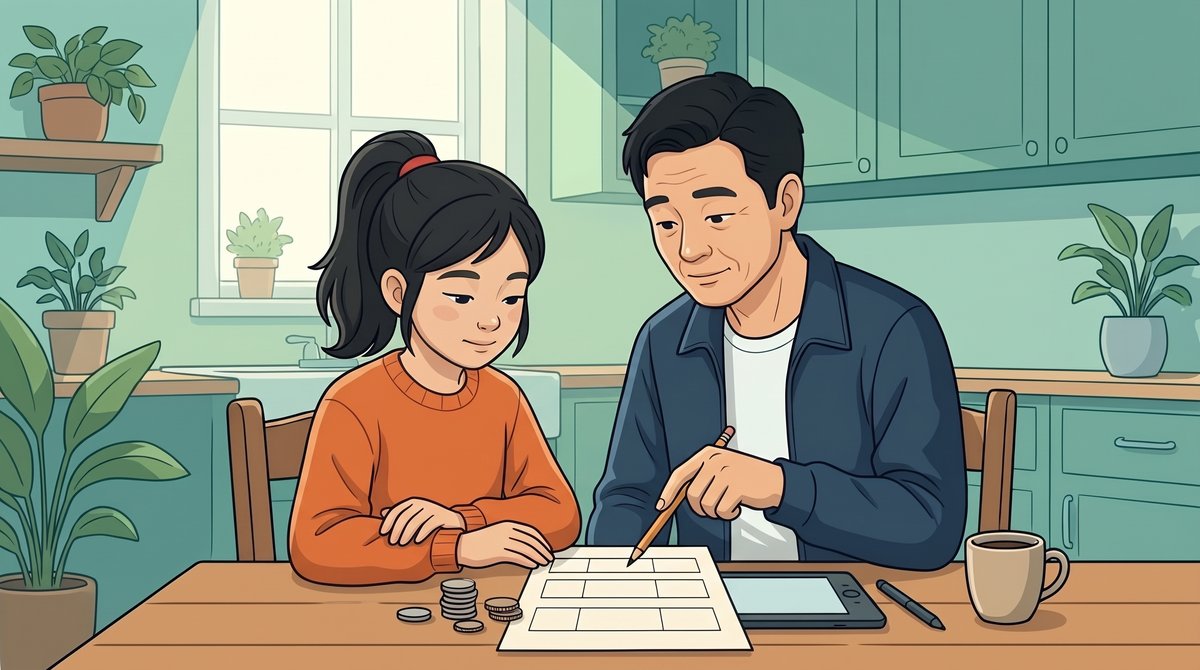
Lucy is twelve years old. She lives in Riverton with her parents and her brothers, Jack and Max. She likes to draw, and last month she made flyers for Rose's Bakery on paper. Now she has a new dream: a drawing tablet that costs $90. With a tablet, she could make better flyers and maybe even sell designs to other shops.
Lucy has only $30 saved. At the kitchen table, she explains her plan to Dad.
Lucy says, "If I save $10 every week, I can buy the tablet in six weeks. But I want to start now. What if I borrow the rest?"
Dad puts down his coffee. He says, "Let's check the numbers."
Dad takes a piece of paper and writes three options.
| Option | How it works | Total Lucy pays | When she gets the tablet |
|---|---|---|---|
| Save first | Save $10 a week | $90 | In six weeks |
| Borrow from Dad | Dad lends $60; Lucy pays $10 a month | $90 | Today |
| Borrow from a lender with interest | The lender charges $6 extra | $96 | Today |
Loans, Installments and Interest
A loan is money that you borrow. You must repay it, which means you give it back. Many loans are repaid in small, equal parts called installments. In Lucy's loan from Dad, she repays $10 each month, six times.
Most lenders also charge interest, which is an extra payment for the use of their money. The interest is the cost of borrowing. A bank or a shop will not lend $60 for free, because they take a risk and they lose the chance to use the money themselves. Dad is her family, so he charges no interest.
Notice that borrowing gives Lucy the tablet now, but it can cost her more, and she has less freedom later. Each month, $10 of her future money is already promised. If she does not repay, she may lose the trust of the lender.
Back to the Kitchen Table
Lucy thinks hard. Then she chooses to borrow from Dad. She says, "I get the tablet today, and I can make flyers for the bakery right away. That might even earn me some money to repay the loan."
Dad writes the plan on a paper and sticks it on the fridge. Lucy signs it: "Lucy owes Dad $60. I will repay $10 on the first of every month."
Six months later, Lucy crosses out the last payment. Dad says, "You kept your word. That is how credit starts. People who repay on time earn trust."
Original ReadLevels article.
Select Vocabulary or Quiz to practice.
Vocabulary
6 key words — tap a word for its meaning and an example
Quiz
6 questions