One article a day, three levels your way.
Free graded English reading: every article comes in Easy, Medium and Hard, with listen-along audio. Vocabulary and quizzes are free with an account. Sign up free →
Longer sentences, more descriptive words (about B1)
Public Goods and Externalities: Who Pays for the Park?
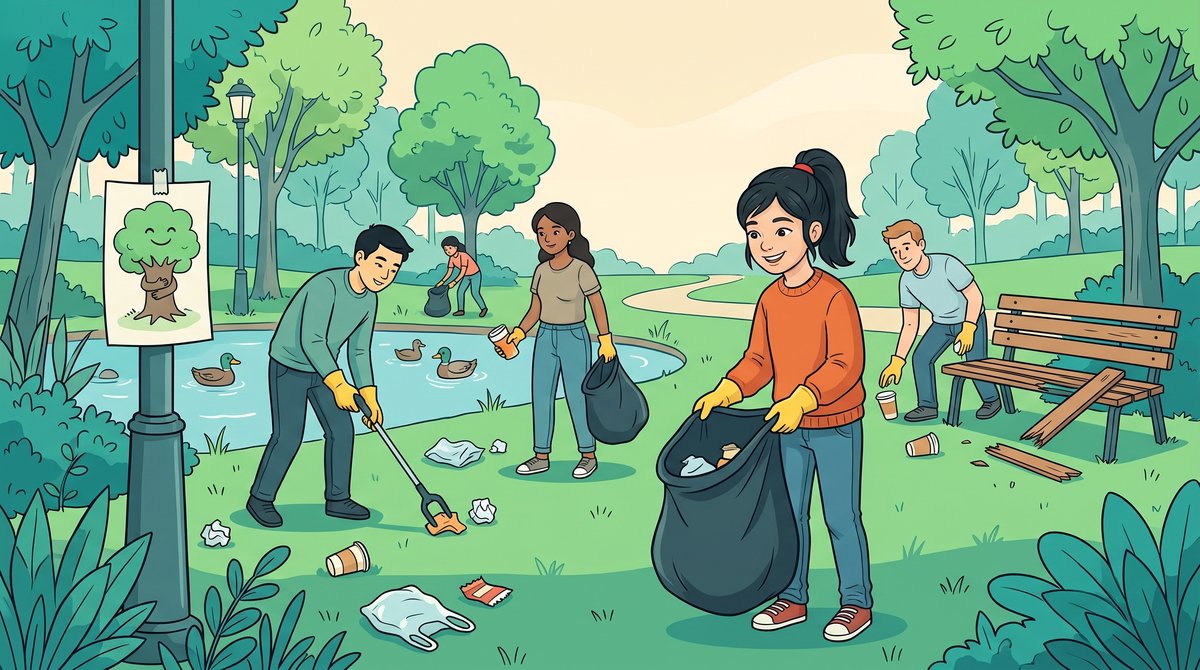
Lucy is twelve years old. She lives in Riverton with her parents and her brothers, Jack and Max. Every week, she walks through Riverton Park on her way to school. The grass is green, the paths are smooth, and the benches are clean. But this spring, something is wrong. There are cups under the trees, the pond has plastic bags, and one of the benches is broken.
At dinner, Dad says, "The town has no money to pay more workers this year. The mayor asks families to help with a clean-up day on Saturday."
Lucy says, "What if we make a poster?"
She draws a poster that says "Park Clean-Up Day" with a picture of a smiling tree, and she hangs it at the bakery and the library.
On Saturday morning, Lucy arrives with gloves, a bag and Max. The town needs 20 volunteers. Only 12 people come. Lucy sees a man who walks his dog in the park every day, but today he is not there. Two neighbors who go jogging in the park every morning stay home.
By noon, the 12 volunteers are tired. The park is clean, but the broken bench is still broken.
Lucy asks Dad, "Why didn't everybody come? They all use the park."
Dad says, "Let's think about it."
Public Goods and Free Riders
A park is a public good. This means two things. First, nobody can easily be kept out. Second, one person's use does not take away another person's use. Streetlights, roads and clean air are also public goods that serve the whole community.
Public goods are a problem for markets. A shop can charge each customer for bread. But a park has no gate, so who should pay?
This leads to the free rider problem. A free rider is a person who enjoys a benefit and does not help to pay for it. A man who uses the park but does not come to the clean-up day is a free rider. If too many people act this way, the public good suffers.
| Way to pay for a public good | How it works | Weakness |
|---|---|---|
| Volunteers | People give their time | Some people do not help |
| Taxes | Everyone pays a small amount | People disagree on how much |
| Donations | People give money by choice | Some people give nothing |
Back to the Park
At the next town meeting, Dad and the mayor agree on a small yearly park fee for every household: $5. The money pays for a worker and the broken bench.
Lucy says, "Now everyone helps, even people who forget to come."
Dad smiles. He says, "That is the idea. When we share a benefit, we should share the cost."
Original ReadLevels article.
Select Vocabulary or Quiz to practice.
Vocabulary
6 key words — tap a word for its meaning and an example
Quiz
6 questions